Story of Puri Temple: Sacred History at a Glance
The story of Puri Temple brings together worship of Shri Jagannath as the Supreme Lord, sacred narratives of Indradyumna and Nilamadhava, and the history of a monumental sanctuary associated with the Eastern Ganga ruler Anantavarman Chodaganga Deva. Ratha Yatra, the temple’s hereditary service traditions and Shri Chaitanya Mahaprabhu’s Gaudiya devotional interpretation remain central to its living heritage. Sacred accounts and historical evidence address different questions; neither should be treated as a substitute for the other.
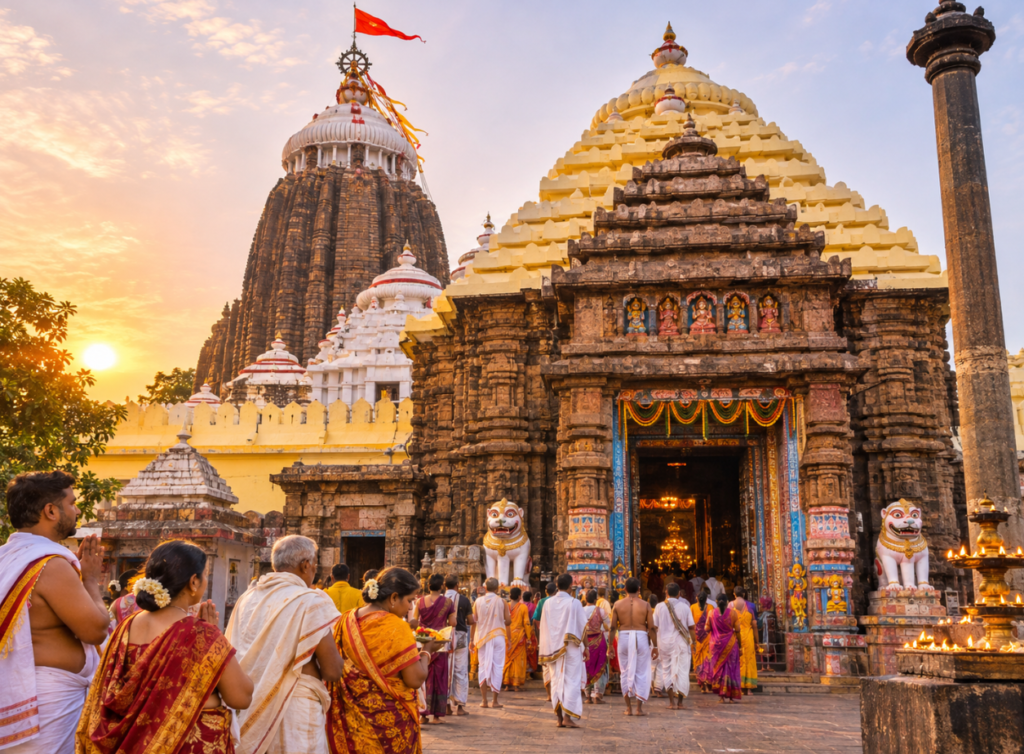
In Puri, on India’s eastern coast, Shri Jagannath’s temple stands at the heart of a living sacred landscape. For Vaisnava devotees, Puri is Purushottama Kshetra, a sacred landscape centred on Shri Jagannath, revered as the Supreme Lord. The name “Jagannath” is commonly rendered “Lord of the Universe.” His presence is approached through inherited rites, festivals, sacred narration and loving service. The story of Puri Temple also invites historical enquiry: inscriptions, royal patronage, temple chronicles and the knowledge of hereditary custodians each illuminate different dimensions of this sacred place. These different forms of understanding should not be collapsed into one another.
The great surviving sanctuary is generally associated with the Eastern Ganga ruler Anantavarman Chodaganga Deva and twelfth-century monumental construction. That attribution does not mark the beginning of all worship at Puri. Historical reconstructions of older Purushottama devotion, changes in royal patronage and the development of ritual institutions must be kept distinct from the sacred narratives through which devotees understand the Lord’s manifestation.
History of Puri: From Purushottama Kshetra to a Pilgrimage City
The name Purushottama Kshetra evokes the sacred domain of Purushottama. The Puri District Administration links an early literary reference to the Sanskrit drama Anargharaghava, associated in its summary with an approximate ninth-century dating. The underlying critical edition and dating argument have not been examined for this article; the reference is therefore presented as an official historical attribution, not as a securely dated record of the current temple. [S01]
The same district account describes a Nagari inscription of Anangabhima III, dated to 1229–1230 CE, that mentions Purushottama Kshetra. The original inscription and its scholarly edition await closer examination. Proposals identifying Puri with the Chinese pilgrim Xuanzang’s Che-li-ta-lo are contested, including in the district’s own historical discussion, and cannot serve here as proof of the site’s early identity.
What emerges is not a single founding date but a sequence: a sacred place known in literature and evolving forms of worship; a medieval royal and architectural centre; and ritual institutions sustained and interpreted across generations.
History of Puri Jagannath Temple: Eastern Ganga Kings and Royal Patronage
Official Odisha tourism and Shri Jagannath Temple Administration materials attribute the monumental temple to Anantavarman Chodaganga Deva of the Eastern Ganga dynasty, whose reign extended across the late eleventh and twelfth centuries. The fabric of a large temple complex, its successive patrons and the history of a deity’s worship cannot all be assigned one date. Epigraphic and architectural scholarship is necessary for a precise reconstruction of building phases.
The early thirteenth century introduces another major royal figure, Anangabhima III. In a 1981 study, historian Hermann Kulke interpreted developments around 1230 CE as a decisive reorientation of kingship: the ruler dedicated his realm to Purushottama-Jagannath and asserted royal authority under the deity’s sovereignty. Kulke also proposed that Balabhadra was most probably introduced into the present triad in this period. The latter is explicitly a scholarly hypothesis, not a demonstrably settled origin date for Balabhadra or for the full configuration of worship.
Other textual and epigraphic discussions complicate attempts to explain Puri’s history through one royal act. The defensible distinction is between earlier devotion to Purushottama, the construction of the extant monument, Anangabhima III’s political-theological claims, and the subsequent organization of temple life. Kulke’s 1981 publication is “King Anaṅgabhīma III, the veritable founder of the Gajapati kingship and of the Jagannātha trinity at Puri” (Journal of the Royal Asiatic Society 113, no. 1, pp. 26–39, doi:10.1017/S0035869X00136810). His separately published 1978 contribution is not that journal article.
Story of Puri Temple: Indradyumna, Vidyapati and Nilamadhava
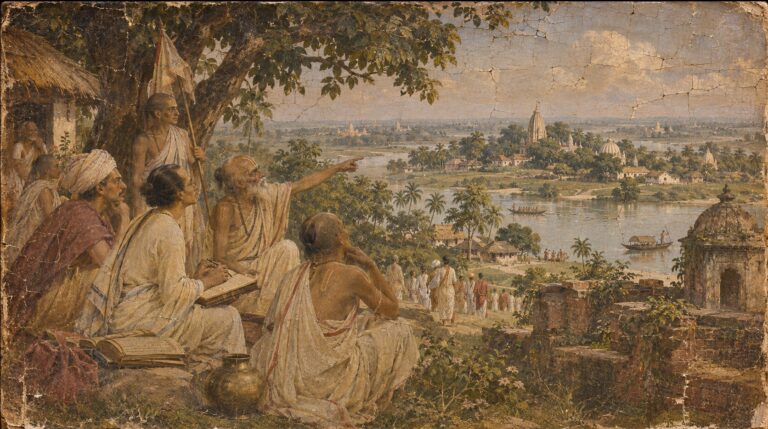
The Purushottama-kshetra-mahatmya, within the Vaishnava-khanda of the Skanda Purana, narrates King Indradyumna’s longing for a vision of Nilamadhava. Vidyapati encounters Vishvavasu, described in this sacred account as a Sabara devotee who worships the Lord in His hidden form as Nilamadhava. In this Puranic sacred account, the encounter expresses divine revelation and devotion; the passage should not be treated as independently dated archaeological evidence. The English rendering used here is associated with G. V. Tagare and is one textual witness within a complex Puranic transmission. Historians may separately investigate material developments at Puri without claiming that the account establishes a single archaeological founding date.
In the cited Puranic account the Lord manifests in sacred wooden forms in association with Balabhadra, Subhadra and Sudarshana; the narrative expresses divine self-manifestation, not merely the manufacture of cult images. For the worshipping tradition Shri Jagannath and the accompanying divine forms are present as living manifestations, not reducible to material artefacts. The sacred narrative itself does not establish the precise manufacture date of the present forms.
In some devotional retellings, a mysterious craftsman, sometimes identified as Vishvakarma, fashions the sacred forms. This article does not attribute that particular episode to a verified verse in the cited Skanda Purana edition. The provenance and textual variations of this telling require separate Sanskrit/Odia specialist checking before any passage-specific citation.
Such accounts deserve neither dismissal nor artificial harmonization. Sacred testimony, local oral traditions and historical explanations can be discussed side by side while preserving their different claims and the authority of those who sustain them.
Why Are Jagannath, Balabhadra and Subhadra Worshipped in Wooden Forms?
The wooden forms are worshipped as living divine manifestations, not simply as artistic objects. Their distinctive appearance has also inspired devotional interpretation and historical enquiry. Their periodic renewal does not, within the devotional understanding, negate the continuing divine identity of the deities. Odisha Tourism describes the publicly known fact of ritual renewal; the Skanda Purana provides sacred narration. Historical investigation and devotional testimony address different questions.
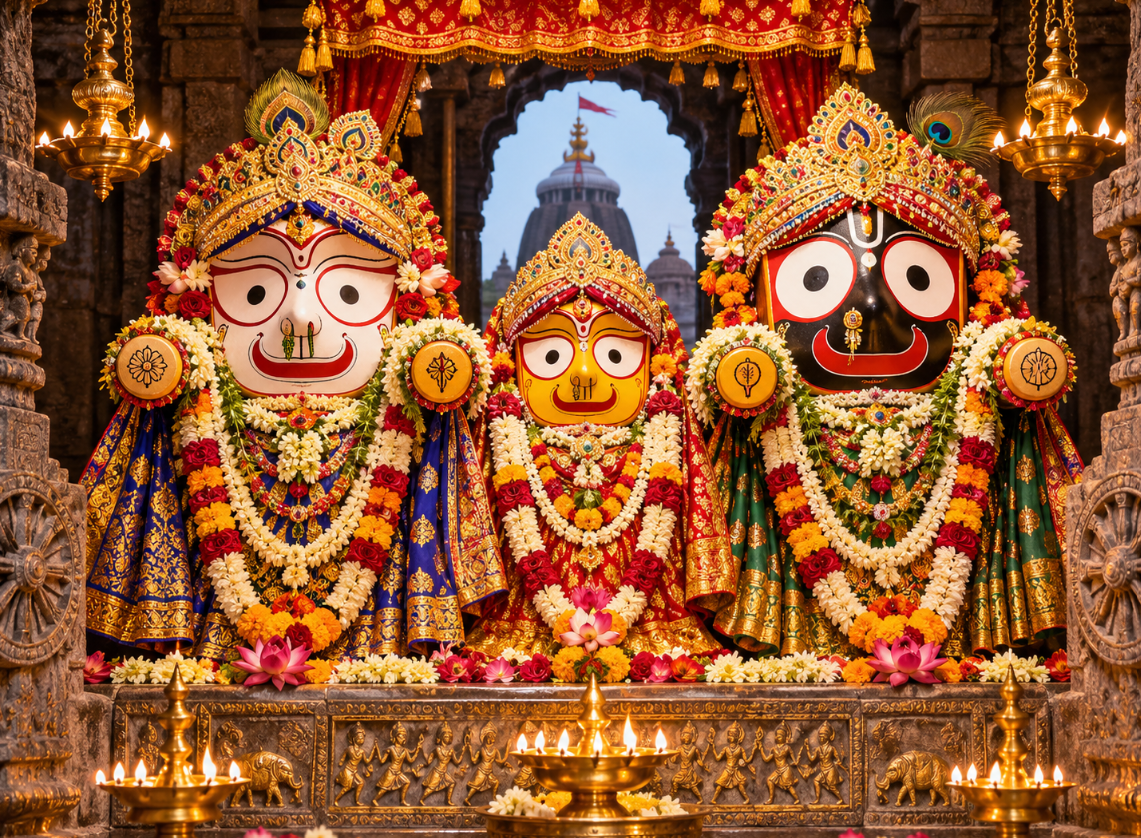
Public accounts identify Daitapati service as part of the temple’s living hereditary traditions. In the sacred account of the Skanda Purana, Purushottama-kshetra-mahatmya, Chapter 19, verse 34, the descendants of Vishvavasu and of the king’s priest are mentioned in connection with future service to the Lord. This is a statement within a Puranic narrative, not independently verified evidence of the genealogy, contemporary identity or legal service rights of present-day Daitapati communities. Public accounts associate Daita and Daitapati service with phases of Jagannath’s ceremonial movement and renewal. Precise current duties, succession and restricted ritual responsibilities require the applicable Record of Rights and suitably authorised local custodial testimony; neither has been independently reconciled for this article. WVA has not interviewed or been authorised to represent these communities.
What Happens at Puri Ratha Yatra?
At Ratha Yatra, Shri Jagannath’s presence is celebrated in a public procession of extraordinary devotional significance. Jagannath, Balabhadra and Subhadra are brought out in the ceremonial movement known as Pahandi and placed on separate chariots for the journey toward Gundicha Temple. The Gajapati ruler’s Chhera Pahanra service is commonly interpreted devotionally as an expression of humility before Jagannath; its contemporary performance remains governed by the temple’s established ritual arrangements. Neither a modern festival summary nor this devotional interpretation is a complete statement of timeless ritual rules.
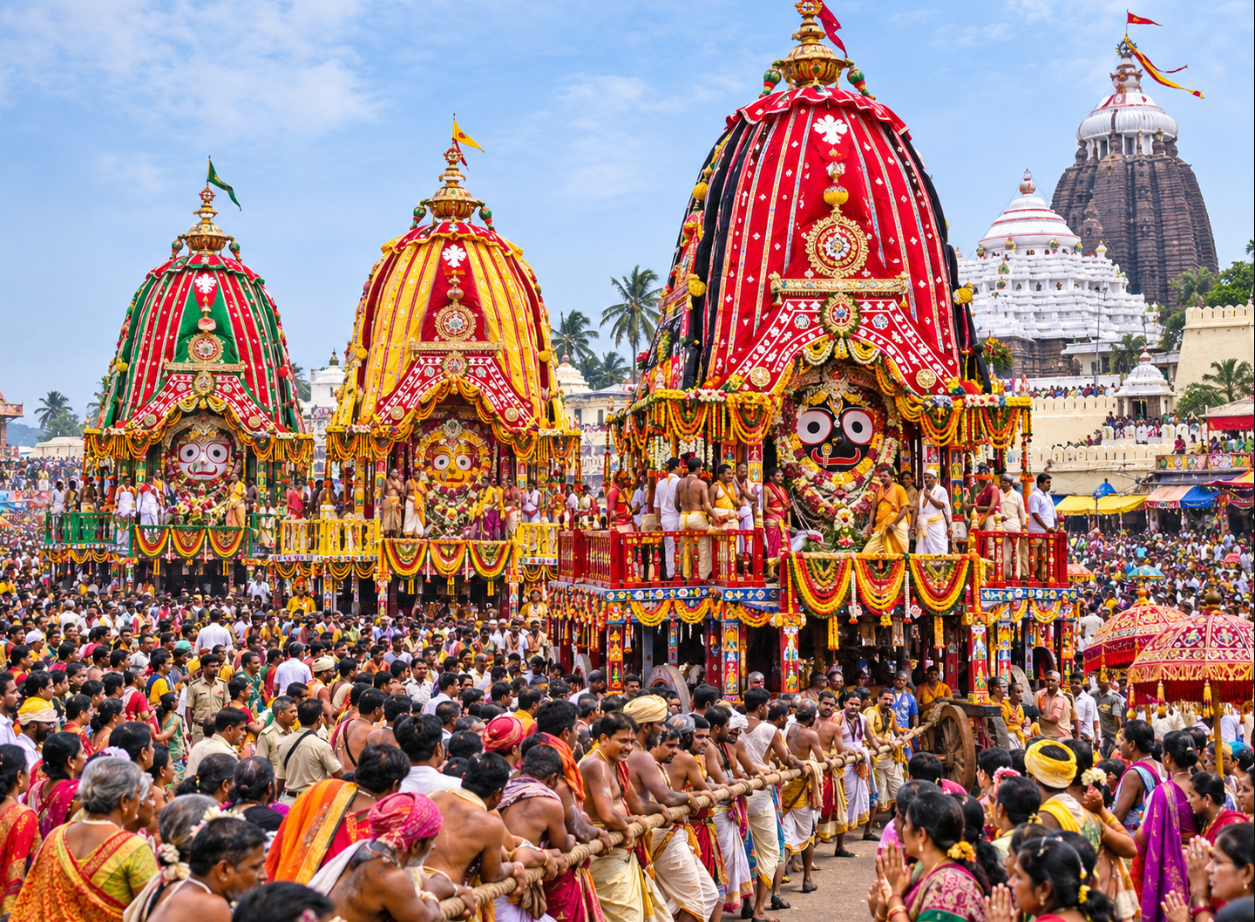
The Skanda Purana’s Purushottama-kshetra-mahatmya also narrates the Gundicha procession (chapter 33). That scripture records a sacred account; it is not a substitute for present-day temple procedure, calendrical notices or the authority of those responsible for the festival.
The beauty of the procession lies not only in the scale of the chariots and the devotion of assembled pilgrims, but in the accumulated skill and stewardship of those whose service makes the festival possible.
Why Is Puri Sacred to Shri Chaitanya Mahaprabhu and Gaudiya Vaisnavas?
For Gaudiya Vaisnavas, Puri is especially associated with Shri Chaitanya Mahaprabhu. For context on the sacred geography of his appearance tradition, see the WVA’s history of Mayapur. Krishnadasa Kaviraja’s Caitanya-caritamrta, composed after Shri Chaitanya Mahaprabhu’s lifetime, preserves a devotional account of his participation in Jagannath worship. It is indispensable for understanding Gaudiya interpretations, but it is not a contemporary manual of Puri temple law or present ritual administration.
According to Caitanya-caritamrta, Madhya-lila 12.72–105, Shri Chaitanya Mahaprabhu first summoned Kashi Mishra, the temple superintendent and Sarvabhauma Bhattacharya (12.72). He then requested permission for Gundicha Marjana (12.73), and the superintendent responded to His request (12.74). Following preparations, Shri Chaitanya Mahaprabhu and His companions began cleansing the Gundicha Temple (12.81). Gaudiya teachers also contemplate this act as an illustration of cleansing the heart so that it may become a fitting place for Shri Krishna. This devotional interpretation is distinct from the narrated actions and does not establish contemporary temple-access rights. [S08: Madhya 12.72–74, 12.81; wider account 12.72–105]
Madhya-lila 13.5–12 describes Jagannath’s ceremonial movement and mentions dayitas, while 13.22 refers to the three chariots. In the Gaudiya understanding expressed in Caitanya-caritamrta, Madhya-lila 13.125–131, Shri Chaitanya Mahaprabhu experiences Jagannath as Krishna and expresses Shrimati Radharani’s longing to bring Krishna from Kurukshetra to Vrindavan. This is a specifically Gaudiya theological reading, not a claim that all Jagannath traditions interpret Ratha Yatra identically. Modern English translations and theological purports must be distinguished from the Bengali verse text. [Madhya 13.5–22, 125–131]
Recognizing that distinction allows the article to honour both the inherited worship of Odisha’s temple communities and the deep spiritual significance that generations of Gaudiya devotees have found in Puri.
What Are Nabakalebara and Jagannath Mahaprasada?
Nabakalebara is the periodic ritual renewal of the sacred wooden forms according to the temple’s inherited service order and calendrical conditions. Within the devotional tradition, renewal of the forms is not an expiration of the Lord’s divinity. Publicly recorded observances include 1996 and 2015, so the rite must not be described as occurring at a fixed twelve-year interval. This educational account limits itself to publicly documented aspects of Nabakalebara and does not describe, reconstruct or imply access to ritual procedures that recognised custodians regard as restricted or confidential.
Mahaprasada is honoured by devotees as the Lord’s sanctified grace received through food offered in worship. In Puri it is also central to patterns of service, distribution and communal devotion. The devotional meaning should not be reduced to a regional culinary custom or a tourism attraction; nor should individual experiences be described as identical.
Ritu Tiwari’s 2026 interpretative phenomenological study drew on 45 qualitative interviews concerning devotees’ experience of temple food customs. Its interviewees reported themes of spiritual connection, community and perceived well-being. Such accounts are valuable evidence of reported experience; they do not establish clinical treatment effects, universal health outcomes or a causal medical benefit from Mahaprasada.
History of Puri Temple: Reading the Madala Panji with Care
The Madala Panji chronicle tradition matters to historians of Puri because it preserves narratives about rulers, ritual life and the temple’s institutional memory. Its transmitted texts, however, include different versions and layers of compilation. A chronicle may illuminate how a community remembered its past without independently verifying the date of every ancient event described in it.
Catalogues identify a digital Odia item edited by Artaballabh Mohanti and associated with Odisha Sahitya Akademi, as well as a distinct 2023 print edition recorded by IIT Bhubaneswar. Neither edition has been collated at the relevant passages for this article. It would therefore be inappropriate to offer apparently precise page references to events that the editorial team has not checked in the original text.
Studies of temple chronicles—including Kulke’s analysis of the Katakarajavamsavali—and comparisons with epigraphic evidence underline why manuscript history, later redaction and inscriptions must be considered together. This article treats the Madala Panji as a historically significant witness that requires source criticism, not as a uniform contemporary register of Puri’s remote antiquity.
Who Governs Jagannath Temple? Visitor Respect and Custodianship
Administration of Shri Jagannath Temple has its own statutory history. The Puri Shri Jagannath Temple (Administration) Act, 1952 is associated with preparation of a Record of Rights concerning service and related responsibilities. The later Shri Jagannath Temple Act, 1955 (Orissa Act No. 11 of 1955) provides a wider statutory framework. The operative effect of amendments, current administration and contested questions of ritual rights are matters for competent legal and temple authorities, not conclusions to be drawn from this introductory article.
Temple entry, photography, recording and ritual access are governed by the competent temple authorities and applicable rules. Visitors should consult current official instructions rather than rely on this historical article for permission guidance. Public Odisha Tourism material describes certain restrictions, but the operative scope, exceptions and current implementation have not been authenticated here; this article makes no independent determination of eligibility or permission.
This is an independent educational article of the World Vaisnava Association. It does not speak for, govern, or claim any legal, administrative, ritual or custodial authority over Shri Jagannath Temple, the Shri Jagannath Temple Administration, the Gajapati institution or any hereditary servitor community, and it implies no endorsement by them. It announces no WVA preservation project and provides no permission for temple entry, photography, recording or restricted ritual participation.
Why Puri Temple Has More Than One Historical Timeline
Puri’s story cannot be told as a single sequence leading from legend to “modernity”. Its sacred narratives speak about divine presence; its inscriptions and material remains illuminate historically constrained developments; Gaudiya literature gives the festival a distinctive interpretation; and local communities preserve ritual knowledge through responsibilities not reducible to either scholarship or tourism.
A responsible encounter with Jagannath therefore makes room for devotion, historical enquiry and respect for living custodianship. Good scholarship can clarify the past without claiming authority over spiritual experience; reverence can deepen care for the heritage without erasing its plural histories or its custodians’ own voices.
Frequently Asked Questions
It is in Puri, Odisha, on India’s eastern coast. The site is traditionally revered as Purushottama Kshetra.
The monumental sanctuary is generally attributed to Eastern Ganga ruler Anantavarman Chodaganga Deva and twelfth-century construction. This should not be confused with the beginning of all worship at Puri.
In the Skanda Purana’s Purushottama-kshetra-mahatmya, King Indradyumna seeks Nilamadhava; the sacred narrative also describes divine manifestations in wooden forms. The article presents this as devotional testimony, not a dated archaeological record.
The festival celebrates Shri Jagannath, Balabhadra and Subhadra in a ceremonial journey towards Gundicha Temple, sustained by the temple’s inherited ritual and service arrangements.
In Gaudiya Vaisnava tradition, Shri Chaitanya Mahaprabhu’s devotion to Jagannath and participation in Gundicha Marjana and Ratha Yatra receive special theological interpretation in the Caitanya-caritamrta.
No. Current eligibility, device rules and permissions must be confirmed with competent temple authorities and their operative notices. WVA holds no temple custodial or administrative authority.
There is no verified list of “ten secrets”; ten documented features are the wooden deities, Nabakalebara, Ratha Yatra, Mahaprasada, earthen-pot cooking, the flag-hoisting ritual, Nila Chakra, Baisi Pahacha steps, four-part sanctuary and Char Dham status. Claims that the temple never casts a shadow or that its flag always defies the wind are popular legends, not established scientific facts.
In the Nabakalebara ritual at Puri, the sacred wooden forms of Jagannath, Balabhadra and Subhadra are renewed. The interval is not exactly twelve years: it depends on the lunar calendar and typically ranges from about 12 to 19 years.
The 22 steps, known as Baisi Pahacha, connect Jagannath Temple’s Lion Gate with its inner courtyard. Devotees associate them with purification and ancestral offerings, but no single historically established explanation accounts for the number 22.
Jagannath Puri is an ancient pilgrimage centre, while its present monumental temple is generally attributed to the twelfth-century Eastern Ganga dynasty. Sacred narratives describe King Indradyumna’s search for Nilamadhava and the manifestation of Jagannath in wooden form; these devotional accounts are distinct from documented architectural history.
References and Further Reading
The following sources offer further reading on the sacred narratives, history, ritual traditions and administration of Shri Jagannath Temple. Scriptural accounts, historical scholarship and official public guidance are presented as distinct forms of evidence. The source codes in parentheses correspond to references used in the article.
Sacred Texts and Devotional Literature
- Krishnadasa Kaviraja. Caitanya-caritamrta, Madhya-lila, Chapter 12 (especially 12.72–105, including the Gundicha Marjana account) and Chapter 13 (especially 13.5–22 and 13.125–131, concerning Ratha Yatra and its Gaudiya devotional interpretation). Bhaktivedanta Vedabase edition. The Bengali text, English translation and explanatory purports should be distinguished. [S08–S09]
- Skanda Purana. Vaishnava-khanda, Purushottama-kshetra-mahatmya, in the English translation associated with G. V. Tagare, available through Wisdom Library: Chapter 7 (Indradyumna and Vidyapati), Chapter 8 (Vishvavasu and Nilamadhava), Chapter 19 (sacred wooden manifestations) and Chapter 33 (the Gundicha procession). A separate online Sanskrit reading text for Chapter 19 is also available. These links represent textual witnesses rather than a completed critical comparison of recensions. [S10–S11]
Historical and Academic Studies
- Patra, Benudhar. “Shree Jagannath Temple at Puri: A Study on Aruna Stambha, Simha Dwara and Baisi Pahacha.” Odisha Review (Government of Odisha), July 2016, pp. 28–33. Study on the temple’s twenty-two steps . The steps’ devotional interpretations are distinguished from independently established architectural history.
- Kulke, Hermann. “King Anaṅgabhīma III, the veritable founder of the Gajapati kingship and of the Jagannātha trinity at Puri.” Journal of the Royal Asiatic Society 113, no. 1 (1981): 26–39. https://doi.org/10.1017/S0035869X00136810 . [S04]
- Eschmann, Anncharlott, Hermann Kulke and G. C. Tripathi, eds. The Cult of Jagannath and the Regional Tradition of Orissa. New Delhi: Manohar, 1978. A collection of scholarly studies; no unverified chapter-specific page citation is implied. [S05]
- Madala Panji / Madalapanji. Two distinct bibliographic records: an Odia digital catalogue item edited by Artaballabh Mohanti and associated with Odisha Sahitya Akademi (2020 catalogue issue; 74 pages), in the CIIL Bhasha Sanchika catalogue ; and a fifth edition edited by Arttaballabha Mohanty (Cuttack: Friend’s Publishers, 2023, xxviii + 80 pages, ISBN 9788174013897), recorded in the IIT Bhubaneswar library catalogue . These are bibliographic records, not independently verified passage-level citations. [S19–S20]
- Tiwari, Ritu. “Impact of temple food customs on devotee’s spiritual wellbeing: an interpretative phenomenological study of Jagannath Temple, Puri.” International Journal of Spa and Wellness 9, no. 2 (2026): 438–450. https://doi.org/10.1080/24721735.2025.2610876 . This qualitative study reports participants’ experiences; it should not be interpreted as evidence of clinical health effects. [S18]
Official and Institutional Sources
- Puri District Administration. “History of Puri.” Official district historical summary . [S01; S24]
- Odisha Tourism. “Shree Jagannath Temple.” Official temple guide , describing the temple, wooden forms, ritual renewal and Mahaprasada. [S03; S16]
- Odisha Tourism. “Ratha Jatra 2026.” Official festival guide , including public descriptions of Pahandi and Chhera Pahanra. [S14]
- Odisha Tourism. “Travel Do’s and Don’ts.” General visitor guidance ; not a substitute for current permissions from the Shri Jagannath Temple Administration. [S15]
- Government of Odisha / India Code. Puri Shri Jagannath Temple (Administration) Act, 1952 (Orissa Act XIV of 1952). Official Act text . [S13]
- Government of Odisha / India Code. Shri Jagannath Temple Act, 1955 (Orissa Act No. 11 of 1955). Official Act text . The cited laws do not substitute for authoritative advice on current amendments, temple access or ritual rights. [S12]