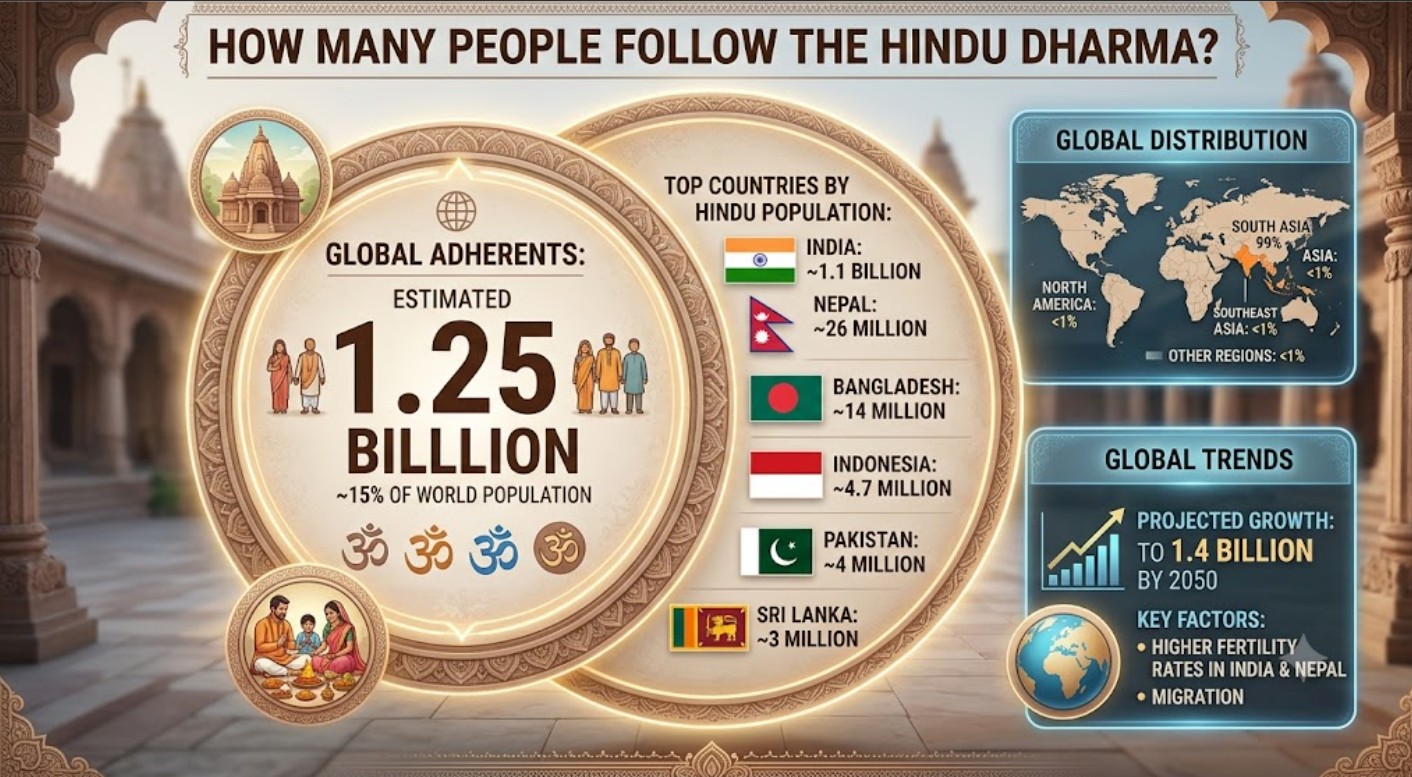
The Sanatana-dharma, or the eternal function of the soul, is not merely a historical designation but a living connection between the jiva (individual soul) and the Supreme Personality of Godhead, Sri Krishna. When we ask, how many people follow the hindu religion, we are looking at a vast global community of seekers who, in various ways, are reawakening their relationship with the Divine.
Current Global Population of Hindus
As of 2021, it is estimated that there are approximately 1.2 billion Hindus globally, representing what percentage of the world practices hinduism—roughly 15-16% of the total human population. This robust following makes it the world’s third-largest religion.
The vast majority of these adherents—about 80%—reside in Bharatavarsha (India), the sacred land where the avataras of Vishnu, including Sri Chaitanya Mahaprabhu, appeared. However, the question of how many people follow hindu in the world extends far beyond India’s borders:
- Nepal: Remains the world’s only Hindu kingdom by majority, with 81% of its population identifying as Hindu.
- Bangladesh: Despite being a minority, Hindus constitute about 8-10% of the population, maintaining a resilient presence in a region deeply touched by the Bhakti movement.
- Global Diaspora: Significant communities have blossomed in the US, UK, Canada, and Australia. From a Gaudiya perspective, this fulfills the prophecy that the holy names of Krishna will be heard in every town and village.
Historical Growth: From the Vedas to the Bhakti Revolution
The roots of Hindu Dharma reach back to the dawn of creation, as recorded in the Vedas. While historians point to the Indus Valley Civilization (3000 BCE) as an early marker, the Gaudiya tradition recognizes a parampara (disciplic succession) that preserves the absolute truth across millennia.
The classical period saw the manifestation of the Upanishads, the Mahabharata, and the Ramayana. However, it was the medieval Bhakti movements that truly “democratized” spiritual life. Sri Chaitanya Mahaprabhu (1486–1534) revolutionized the landscape by teaching that through the Sankirtana (congregational chanting) of the Maha-mantra, anyone—regardless of caste or creed—can attain prema, or pure love of God. This spirit of inclusion is a primary reason why how many people follow hindu continues to grow today.
Geographic Distribution & Diaspora
India remains the spiritual heart, containing 94% of the global Hindu population. Sacred dhamas like Varanasi, Vrindavan, Puri and Mayapur attract millions of pilgrims seeking darshan (divine vision).
Outside South Asia, the dispersion of Hindus has created a “Global Vaikuntha” (spiritual atmosphere) in unexpected places. In Bali, Indonesia, a unique blend of Vedic and local traditions persists, while Western cities are now home to magnificent temples where the tradition of Bhagavad-gita is studied by people of all ethnic backgrounds.
Demographics and the Digital Age
The demographics of those who follow Hinduism are incredibly diverse, encompassing various linguistic and social backgrounds. Interestingly, the religion maintains a very youthful profile:
- Youthful Energy: In India and Nepal, a high percentage of followers are under the age of 30.
- Technological Integration: This generation uses digital platforms for sanga (association). Online resources and virtual darshans have made it easier for young seekers to discover how many people follow hinduism worldwide and connect with global Bhakti communities.
- Gender Dynamics: While traditional structures exist, the Gaudiya tradition emphasizes that the soul has no material gender. Today, more women are taking on roles as scholars, kirtan leaders, and community guides.
Major Festivals: The Joy of Krishna-Lila
Hindu festivals are not merely social gatherings; they are windows into the spiritual world.
- Diwali: The Festival of Lights commemorates the return of Lord Ramachandra, signifying the victory of dharma over adharma.
- Holi: Symbolizes the playful love of the Divine Couple, Radha and Krishna.
- Navaratri: Celebrates the strength of the Goddess Durga, the external energy of the Lord who protects the world.
These celebrations are a major gateway for the world to experience the vibrancy of Vedic culture.
Influence on Global Culture
Hinduism’s impact is undeniable. The global embrace of Yoga—originally a discipline to link the soul with the Supreme—has made the tradition a household name. Furthermore, the Bhagavad-gita continues to be one of the most translated and influential philosophical texts in human history, guiding leaders and thinkers toward a life of selfless duty (karma-yoga).
Comparison and Future Projections
Unlike linear religions, Hinduism views time as cyclical (yugas). This inclusive, pluralistic approach allows for various levels of understanding of the Divine. Looking ahead, the number of people who follow the Hindu religion is projected to rise. Through interfaith dialogue and the continued spread of Bhakti through modern technology, the timeless wisdom of the Vedas is set to remain a guiding light for humanity.
Key Takeaway: Whether you look at the 1.2 billion figure or the 16% global share, the true metric of Hinduism’s success is the number of hearts awakened to their eternal spiritual nature.
Frequently asked Questions
Approximately 1.2–1.3 billion people identify as Hindus, making Hinduism the world’s third-largest religion.
Hindus make up about 15% of the global population.
India has the largest Hindu population, with nearly 80% of all Hindus living there.
No. Nepal became a secular republic in 2008, although it remains a Hindu-majority country.
No. Millions of Hindus live in countries such as Nepal, Bangladesh, the United States, the United Kingdom, Canada, Australia, and many others.
Hindu dharma is a diverse spiritual tradition that includes many philosophical schools, lineages, and forms of worship while sharing common Vedic roots.
Yes. Hindu communities continue to grow worldwide through migration, cultural exchange, yoga, and the increasing interest in Vedic philosophy and bhakti traditions.
Leave a Reply