History, Philosophy, Spiritual Traditions and Global Communities
Discover the Living Heritage of Vaishnavism
Vaishnavism encompasses a rich family of spiritual traditions centred on devotion to Lord Vishnu, Krishna, Rama and other divine manifestations honoured within the different Vaisnava sampradayas.
Rooted in sacred scriptures, spiritual lineages and the practice of bhakti—loving devotion to the Supreme Lord—Vaisnava traditions have shaped religious philosophy, literature, music, sacred architecture, pilgrimage and community life across generations.
The World Vaisnava Association (WVA–VVRS) presents this collection of educational articles to encourage a deeper understanding of Vaisnava history, philosophy, spiritual heritage and international communities.
We recognise the distinctive teachings and independent identities of different Vaisnava missions while encouraging respectful cooperation.
Unity in Diversity — Independent Missions. One Shared Voice.
The History and Origins of Vaishnavism
The origins of Vaisnava traditions are understood through both sacred revelation and historical study.
Within Vaisnava theology, spiritual knowledge is transmitted through ancient scriptures and recognised lineages of teachers. Devotees regard these teachings as part of an enduring spiritual tradition.
Historical scholarship examines a different set of questions: the development of religious communities, the transmission of texts, the emergence of identifiable devotional movements and their influence across different regions and periods.
These approaches need not be confused. Sacred traditions communicate theological understanding and devotional meaning, while historical enquiry investigates developments supported by available evidence.
Understanding both perspectives helps readers appreciate the depth and continuity of Vaisnava heritage without reducing religious testimony to historical conjecture or treating every traditional chronology as independently documented history.
Explore further: The Origin of Vaishnavism
Vaisnava Philosophy and Spiritual Traditions
Vaisnava philosophy places devotion to the Supreme Divine Person at the centre of spiritual life.
Its teachings explore the nature of the soul, the relationship between the individual living being and the Supreme Lord, moral responsibility, divine grace and the ultimate purpose of spiritual existence.
The Bhagavad-gita, Srimad Bhagavatam and other sacred works are especially influential across many Vaisnava traditions.
Different sampradayas offer distinct philosophical explanations of the relationship between the Supreme Lord, individual souls and the world. Their differences are part of the intellectual and spiritual richness of Vaisnava heritage and should be represented accurately rather than artificially harmonised.
The Vaisnava Sampradayas
Among the influential traditions associated with Vaisnava history are the Sri, Brahma-Madhva, Rudra and Kumara lineages and their later branches and theological developments.
These traditions preserve distinctive teachings, forms of worship, institutional histories and spiritual succession.
The Gaudiya Vaisnava tradition, particularly associated with Shri Chaitanya Mahaprabhu, places special emphasis on loving devotion to Shri Krishna and the congregational chanting of divine names.
The WVA is rooted in Gaudiya Vaisnava heritage while respecting other Vaisnava sampradayas and the autonomy of their institutions.
Vaishnavism Around the World
Vaisnava traditions are practised by communities in India and across the international diaspora, including Asia, Europe, the Americas, Africa and other regions.
Their global presence reflects centuries of cultural transmission, pilgrimage, spiritual teaching, migration and the development of devotional communities.
However, determining the total number of Vaisnavas worldwide is methodologically challenging.
National censuses generally do not provide consistent global figures for individual Vaisnava traditions. Religious identities may overlap, and different studies use different definitions of affiliation, practice and denominational belonging.
For this reason, claims about the global Vaisnava population require careful attention to the source, year, geographical coverage and research methodology.
Explore further: How Many Vaishnavas Are There in the World?
Vaisnava Heritage in a Wider Religious Context
Understanding Vaisnava communities also involves recognising the wider religious and cultural environment in which they developed.
Modern population studies frequently use the umbrella category Hinduism to classify diverse religious communities. That designation does not necessarily capture the distinct spiritual identity, philosophical positions or institutional affiliations of individual Vaisnava traditions.
Demographic research can offer useful context, but broad religious population estimates should never be treated as equivalent to the number of Vaisnavas.
For readers interested in the wider statistical context, the following article examines global population figures from a Gaudiya Vaisnava perspective.
Related research: How Many People Follow the Hindu Religion?
Sacred Heritage, Education and International Cooperation
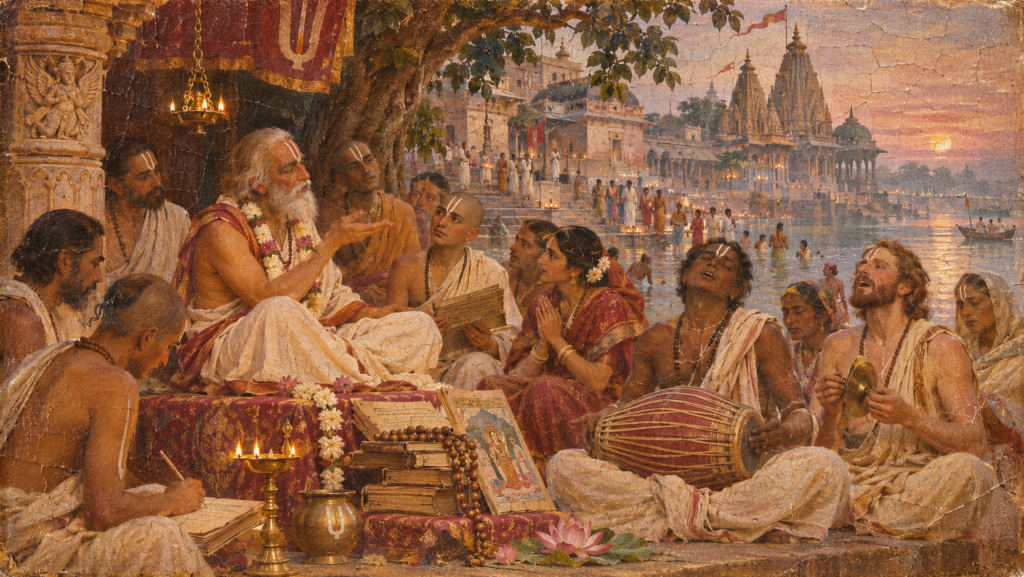
Vaisnava heritage is preserved not only in books and historical records, but also through living temples, pilgrimage places, spiritual practices, sacred music, festivals and the service of devotional communities.
Protecting this heritage requires respect for local custodians, established spiritual lineages, institutional responsibilities and the people whose lives are connected with these traditions.
Independent Vaisnava missions may contribute through education, research, cultural preservation, devotional service and voluntary cooperation.
The World Vaisnava Association seeks to strengthen understanding and constructive relationships among these missions without replacing their leadership, governing their institutions or imposing theological uniformity.
Our guiding principle is simple:
Unity does not require uniformity. Cooperation does not require surrendering independence.
Learn more about the WVA’s principles and its commitment to Education & Knowledge.
Frequently Asked Questions About Vaishnavism
What is Vaishnavism?
Vaishnavism refers to a family of spiritual traditions centred on devotion to Lord Vishnu, Krishna, Rama and other divine manifestations recognised within Vaisnava teachings. Its diverse lineages share an emphasis on devotion while differing in philosophical interpretation and religious practice.
What are the main teachings of Vaishnavism?
Central teachings include the eternal nature of the soul, devotion to the Supreme Lord, spiritual discipline, divine grace and the cultivation of a loving relationship with God. Distinct sampradayas explain these subjects through their own authoritative texts and teachers.
How old is Vaishnavism?
Vaisnava traditions understand their spiritual origins through sacred revelation and the transmission of divine knowledge. Historical scholarship studies their documented development through scriptures, inscriptions, religious movements and institutional records. These are different ways of approaching the question of origins.
What are the major Vaisnava traditions?
Important Vaisnava lineages include the Sri, Brahma-Madhva, Rudra and Kumara traditions, together with their historical branches and later developments. They preserve distinct philosophical teachings, devotional practices and forms of spiritual succession.
How many Vaishnavas are there worldwide?
There is no universally accepted global census count of Vaisnavas. Estimates depend on definitions, regional data and research methodology. Broad population figures for Hindu communities cannot automatically be interpreted as Vaisnava population figures.
What is the World Vaisnava Association?
The World Vaisnava Association (WVA–VVRS) is an international cooperation initiative supporting dialogue, shared interests and responsible collaboration among independent Vaisnava missions. It respects the spiritual and institutional autonomy of participating organisations and does not claim to govern all Vaisnavas.
Explore the World Vaisnava Association
Discover how independent Vaisnava missions can contribute to a shared culture of knowledge, mutual respect and meaningful cooperation.
Read more about our mission and principles, explore cooperation opportunities, or contact the WVA for further information.
United in Dharma. Stronger Together.


